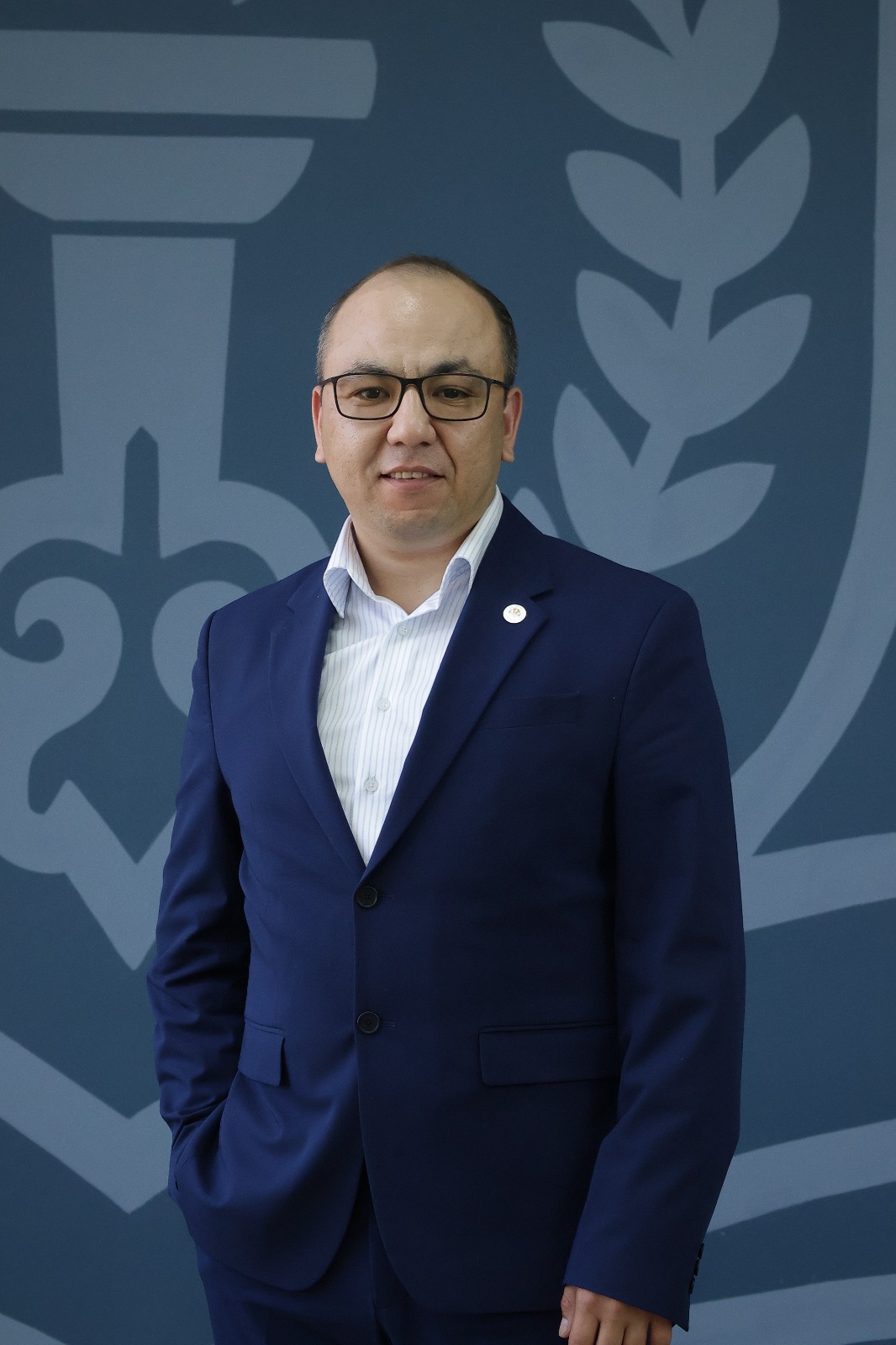
Orazov Ayan
Head of Department, Candidate of Technical Sciences
+7 7172 69 70 50 (122)
3/207
The department trains highly qualified specialists in the field of standardization and certification, biotechnology, and the food and processing industries. It was founded in 1998.
Orazov Ayan
Head of Department, Candidate of Technical Sciences
+7 7172 69 70 50 (122)
3/207
The Department of "Technology and Standardization” is aimed at training qualified professionals capable of effectively optimizing and designing production processes, implementing advanced solutions in biotechnology and technical regulation, and ensuring strict quality control and product safety in the context of the rapid development of the innovation economy.
The Department of “Technology and Standardization” was established on September 1, 1998, on the basis of the branch of the Almaty University of Technology and Business. Its establishment was made possible through the initiative of the First Vice-Rector for Academic Affairs, Doctor of Technical Sciences, Professor Zh.K. Usembaeva. During the formative stage of the department, leading specialists from food and processing enterprises of the Republic of Kazakhstan were actively involved in the educational process, which ensured a strong connection between theoretical training and industrial practice.
Development of Educational Programs
In 2003, by order of the Rector, the department was renamed the Department of “Technology and Standardization” within the Faculty of Technology. From the first years of its activity, the department has been training highly qualified engineers-technologists and experts for the food and processing industries of the agro-industrial complex of the Republic of Kazakhstan. Over the years of its operation, the department has trained more than 15,000 specialists.
Initially, training was carried out in the following educational areas:
Thanks to the initiative of Professor Zh.K. Usembaeva, Master's degree programs were launched in 2003 in the following fields:
Since 2004, the implementation of Bachelor’s degree programs has been carried out under the leadership of Professor Zh.K. Usembaeva, with the active participation of lecturers K.Zh. Kirgizbayeva, G.S. Zhunusova, A.A. Bekturganova, and G.E. Yesirkep.
Academic Staff
The establishment and development of the department were significantly contributed to by lecturers whose professionalism, scientific activity, and pedagogical excellence formed a solid foundation for specialist training. Over the years, the department has employed doctors and candidates of sciences, professors, associate professors, senior lecturers, lecturers, and laboratory staff, many of whom are highly respected by graduates and colleagues.
Among them:
The first lecturers of the department were:
Heads of the Department
🔹 1998–2003 — Kurmangalieva D.B., Candidate in Technical Sciences, Associate Professor, first Head of the Department.
🔹 September–December 2003 — Kirgizbayeva K.Zh., Candidate in Technical Sciences.
🔹 2003–2004 — Shakirov A.T., Doctor of Technical Sciences, Professor.
🔹 2004–2005 — Oshakaev P.O., Candidate in Technical Sciences, Associate Professor.
🔹 2005–2006 — Zhunusova G.S., Candidate in Technical Sciences, Associate Professor.
🔹 2006–2008 — Ospanova M.Sh., Doctor of Technical Sciences, Professor.
🔹 2009–2012 — Safuani Zh.E., Candidate of Biological Sciences, Associate Professor.
🔹 2012–2016 — Omaralieva A.M., Candidate in Technical Sciences, Associate Professor.
🔹 2016–2017 — Yesirkep G.E., Candidate in Technical Sciences, Associate Professor.
🔹 2017–2023 — Zhunusova G.S., Candidate in Technical Sciences, Associate Professor.
🔹 2023–2025 — Baitukenova S.B., Candidatein Technical Sciences, Associate Professor.
🔹 From 2026 to present — Orazov Ayan Zharilkasinovich, Candidate of Technical Sciences, Acting Associate Professor-Researcher.
Priority Areas of Department Development
The activities of the department are aimed at developing educational, scientific, and innovative work, strengthening cooperation with industrial enterprises, and training specialists who meet the modern requirements of the food and processing industries.
🔹 Training highly qualified specialists in the fields of food technology, processing industries, biotechnology, and quality management systems, capable of effectively solving industrial, scientific, and innovative tasks.
🔹 Development of research activities in food technology and biotechnology, creation of innovative products and raw material processing technologies, improvement of quality and safety control systems, and implementation of modern scientific achievements in industry.
🔹 Integration of the educational process with industrial enterprises, testing centers, and technical regulation organizations to develop practical skills in working with modern equipment, measuring instruments, and product quality assessment methods.
🔹 Training specialists capable of working under international requirements for product quality, safety, and sustainable development, with advanced competencies in digital technologies, production automation, and intelligent quality control systems.
🔹 Expansion of international cooperation in education, science, and professional training, as well as fostering professional responsibility and commitment to continuous professional development.
Educational Activities
The educational trajectory of the Department of “Technology and Standardization” is aimed at training highly qualified specialists capable of becoming leaders in the food, processing, and biotechnology industries, as well as experts in technical regulation and quality management. The department’s academic process combines fundamental theoretical training with practical mastery of modern industrial standards and technologies.
During the learning process, students acquire:
🔹 modern technologies for food production and deep processing
🔹 advanced methods of industrial biotechnology
🔹 quality control systems, standardization tools, and technical regulation methods
A significant part of the training is focused on practice-oriented education: laboratory research, participation in project activities, scientific research work, and solving current industrial challenges.
Special attention is given to key areas of the modern food industry:
🔹 food safety — end-to-end quality control at all stages from raw materials to finished products
🔹 nutrition innovations — development of functional and specialized next-generation food products
🔹 biotechnological solutions — implementation of eco-friendly and advanced biological methods in production
🔹 metrological support — modern approaches to standardization and certification in the context of digitalization of the agro-industrial complex
The department actively develops a system of strategic partnerships with food industry enterprises, research centers, and testing laboratories. This ensures direct connection with employers, development of strong professional competencies, and high readiness of graduates for rapid integration into professional practice.
6B07525 - Standardization, Certification and Metrology (by Industry)
The educational program is aimed at training specialists in technical regulation, metrological support, and conformity assessment of products according to national and international standards. Students master the principles of building modern quality management systems and protecting consumer interests.
Career pathways:
🔹 national and international standardization, certification, and metrology centers
🔹 accredited testing laboratories and independent expert organizations
🔹 state bodies for technical regulation, control, and customs supervision
🔹 research and design institutes
🔹 quality control services in enterprises across various industries
6B07220 - Technology of Food Products
The educational program is aimed at training engineers-technologists capable of designing and modernizing meat and dairy processing lines. Graduates develop formulations of safe and competitive products and manage technological processes in modern food production facilities.
Career pathways:
🔹 meat, dairy, and food industry enterprises
🔹 catering, restaurant business, and food service holdings
🔹 production-technological and analytical laboratories
🔹 product expertise, certification, and quality control centers
🔹 research institutes and educational organizations
6B07223 - Food Processing Technologies (by Industry)
The program is aimed at training engineers-technologists in the field of deep grain and plant raw material processing. Students study technologies for the production of flour, cereals, bakery, pasta, and confectionery products, as well as methods for optimizing technological processes and implementing modern solutions.
Career pathways:
🔹 grain processing complexes, elevators, and flour mills
🔹 bakery, pasta, and confectionery enterprises
🔹 agro-industrial holdings and agricultural enterprises
🔹 production-technological laboratories
🔹 standardization and certification bodies for plant-based products
🔹 research centers
6B05112 - Biotechnology
The educational program prepares specialists in biotechnology, microbiology, food safety, and the development of innovative bioproducts. The program combines biological and engineering approaches and is aimed at training researchers and practitioners in industrial biotechnology.
Career pathways:
🔹 biotechnology and food industry enterprises
🔹 microbiological, virological, and molecular genetic laboratories
🔹 pharmaceutical companies and bioproduct manufacturers
🔹 environmental organizations and monitoring services
🔹 product safety control laboratories
🔹 research institutes and higher education institutions
7M07239 - Technology of Food Products
The Master's degree program is aimed at training scientific personnel, senior executives, and chief technologists. Master’s students acquire advanced competencies in modeling innovative food technologies, conducting comprehensive scientific research, and strategic management of high-tech food production facilities.
Career pathways:
🔹 large food industry holdings (chief technologists, R&D directors)
🔹 research institutes, analytical centers, and laboratories
🔹 R&D centers for the development and implementation of new products
🔹 international auditing companies for quality control
🔹 higher education institutions and specialized colleges
7M07241 - Food Safety
The program is aimed at training experts in ensuring the quality and safety of food products, risk management, and the implementation of international standards such as HACCP, ISO, and modern food safety control systems in food production.
The program develops internationally qualified specialists with competencies in risk management tools, safety system auditing, implementation of HACCP, ISO, and FSSC standards, as well as ensuring the safety of food supply chains.
Career pathways:
🔹 quality and food safety departments (QA/QC) of large industrial corporations
🔹 international accredited laboratories and expert-analytical centers
🔹 sanitary-epidemiological control and state supervision authorities
🔹 international organizations for standardization, certification, and consulting
🔹 food safety research centers
🔹 higher education institutions (scientific and teaching activities)
The research activities of the Department of “Technology and Standardization” are aimed at addressing current challenges in the food, processing, and biotechnology industries, developing innovative technologies for food and biotechnological product production, as well as improving and managing product quality and safety.
The department’s academic staff successfully implement research projects within the grant funding programs of the Ministry of Science and Higher Education of the Republic of Kazakhstan, actively involving undergraduate students, master’s students, and young researchers in scientific activities.
🔹 Under the supervision of A.Zh. Khastayeva, the research project IRN: BR10764970 “Development of technology for grain-based ‘milk’ beverages enriched with omega-3 polyunsaturated fatty acids” was completed.
🔹 Under the supervision of M.Ch. Tultabayev, within the grant funding programs of the Ministry of Science and Higher Education of the Republic of Kazakhstan, the following research projects were implemented: IRN BR10764977 “Development of technology for obtaining water–oil food emulsions from safflower seeds for the production of new types of food products” and IRN AP23488817 “Development of technologies for producing vitamin-enriched oxygenated beverages using the Scheffé simplex-lattice design.”
🔹 Under the supervision of A.M. Omaralieva, the scientific and technical program IRN BR24993031 “Development of technology for the production of confectionery products (cookies and gingerbread) based on dry powders of melon and fruit-berry crops” is being carried out.
The results of the department’s research are integrated into the educational process, used in the preparation of diploma and master’s theses, published in scientific journals, and presented at international scientific and practical conferences. The integration of science, education, and production contributes to the training of highly qualified specialists capable of addressing modern technological challenges in the agro-industrial complex and food industry.
View photos, events, and life of our department in the university gallery.